I believe that several people knew about my secret mission with Master Lianhuo this week. Master Lianhuo and I went to Hong Kong on Monday and only returned today, arriving back in Seattle around 1:00pm. From Monday to Saturday, Master Lianhuo and I were in Hong Kong. Although it was a secret mission, and no one knew about it, there’s a saying in Taiwanese: “Even the tightest duck egg will have a crack.”
Why do I say so?
Because at Hong Kong airport, when we disembarked, the airport staff member—the gentleman towing the plane—was our disciple. He recognized us immediately by the “True Buddha School” logo on our bags and my face.
Back in Seattle, our disciple Mrs. Wen, who works as a translator at immigration and customs, also saw us at the airport. She was very surprised to see us! Why were we coming off an international flight?
Because we hadn’t told anyone last Saturday that we were going to a distant place or another country.
Our main purpose in going to Hong Kong this time was for the future, so that when we travel around, we would have a base in Hong Kong. Hong Kong disciples had sincerely donated a house to us, so that in future when we travel around the world, we would have a base in Hong Kong, a place to stay there.
So on the first day, we were busy opening a bank account. On the second day, we were busy signing the ownership transfer documents at the law firm. And on the third day, we were still signing these certificates.
The disciples in Hong Kong were very sincere. That house has a large living room, perfect for expounding the dharma, three bedrooms upstairs, a garage for two cars, gardens in the front and back, two sets of sanitary facilities, and a bird conservation area behind the house where no more buildings can be constructed—the environment is extremely beautiful.
I think that when our True Buddha School masters go to Hong Kong to spread the Dharma in the future, they can stay in this house. They sincerely gave such a nice house, worth hundreds of thousands of US dollars, to the Masters.
Actually, as I mentioned last time, having so many houses doesn’t necessarily have advantages. Even before moving in, you already have to pay for water, electricity, cleaning, miscellaneous expenses, management fees, parking fees—you name it.
However, I believe there are still benefits, because that one house would serve as a center for traveling and spreading the Dharma.
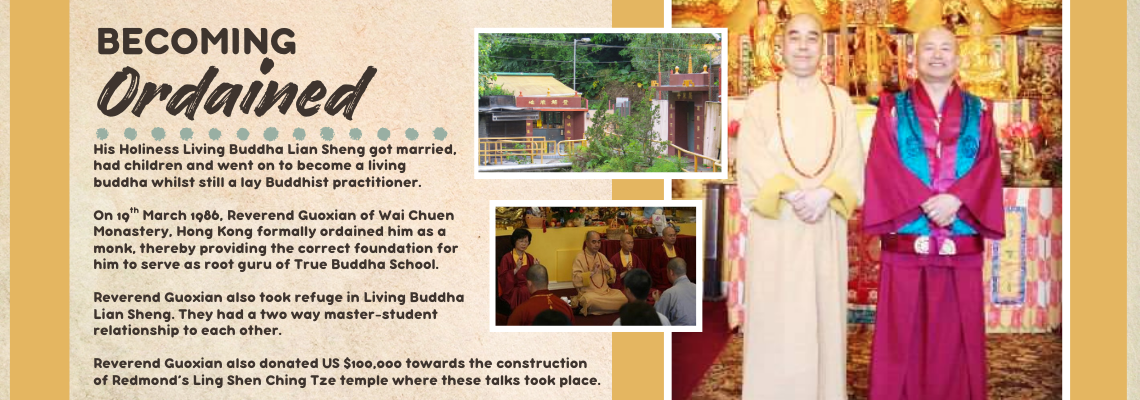
In Hong Kong, I said I wouldn’t let everyone know, but in reality, the Masters there knew. I gave some Dharma talks when I was with Master Gao Anmin, and when with Master Guoxian, I also gave some dharma talks to his disciples too.
The rest of the time was spent eating.
Due to the fact that time was very limited in Hong Kong, I only actually spent three days there.
Sometimes people might think, “The Masters have it good, they are gifted cars, houses, and have houses all over the world, why don’t they give us one?”
However, I believe these houses will be used in the future as a center for the True Buddha School’s Dharma propagation, not for my personal use—staying here one day, flying there the next, and then flying to another place the day after. It’s not for that kind of enjoyment.
In “The Buddha Speaks of Amitabha Sutra” the Buddha expounded the Amitabha Sutra at the Buddha’s monastery at Jetavana. Actually this Buddha’s monastery at Jetavana was also gifted to him by his disciples.
Two people donated Jetavana Monastery to Shakyamuni Buddha. One of them was Prince Jeta of Shravasti, who originally owned the monastery but sold it to the minister Anathapindada, and he then also donated all the trees on the land to Shakyamuni Buddha. Therefore, the true name of the Buddha’s Monastery at Jetavana is “Anathapindada’s park at Jetavana.”
What does “Jetavana” mean? It means that Jeta donated all the trees on the land to Shakyamuni Buddha, hence the name “Jetavana.”
“Giving to the lonely” doesn’t mean giving to the forlorn/lonely. This name is quite strange, why is it called “giving to the forlorn/lonely”?
The origin of this name was that this minister was dedicated to helping people by doing good deeds. He helped the elderly without children and the young without parents, ensuring they were not lonely, much like building nursing homes and orphanages. Nursing homes are for the elderly without children, and orphanages are for the young without parents. Because this minister often helped these lonely elderly people and lonely young people, everyone respectfully called him “Giving to the lonely.”
When the Buddha was expounding the dharma in Shravasti, Anathapindada and Prince Jeta gifted this vast garden to him. With this large plot of land and such a beautiful forest, the Buddha settled his thousands of disciples in the Anathapindada’s park at Jetavana, allowing them to peacefully reside and cultivate. Because the Buddha received this garden, he was able to expound the dharma and liberate sentient beings, this accomplishment is called “the accomplishment of location.”
In future, all these centers of ours will become centers for spreading the Dharma, for expounding the dharma, and for cultivators to roam, they will appear all over the world. Therefore, please do not regard these houses as the private property of your Guru, because in future they will all contribute to the power of propagating the Dharma.
I know that as long as we diligently propagate the Dharma, Heaven will prepare many dwellings for us. Heavenly wealth is inexhaustible and limitless, as long as we earnestly perform our Dharma activities, the Buddhas and Bodhisattvas will prepare all the necessary places for us to propagate the Dharma.
This is what Master Zheng meant today when he said, “Those who attain the Way naturally receive much help.”
Those who attain the Way naturally have many people to help them.
They don’t seek wealth, yet it comes naturally.
They don’t need to seek fame, yet they are world famous.
Therefore, nowadays I often think, where is my wealth? I believe my wealth is not on earth, but in the vast emptiness.
“The vast emptiness is filled with wealth, therefore you naturally possess everything.”
Om Mani Padme Hum