
The first sentence of the Amitabha Sutra mentions several terms:
“Thus I have heard. At one time the Buddha was at Shravasti, Anathapiṇḍada’s park at Jetavana, together with a gathering of great bhiksus 1250 in all, all great Arhats whom the assembly knew and recognized.”
Last time we talked about Anathapiṇḍada’s park at Jetavana, today we’ll talk about what “great bhiksus” means.
Great bhiksus is referring to ordained senior monks. When most people hear the word “monk,”… people from Guangdong are terrified! Master Guoxian encountered one in Chinatown.
Actually, monks aren’t usually scary, but people from Guangdong are very afraid of them, which I find strange. Last time, an older lady saw a Master and exclaimed, “Oh dear! What bad luck!”
The Master went up to her and said, “You’re not unlucky! I can bless you.”
As they both spoke Cantonese, thus I assumed the monk had relatives here and they were greeting each other. They talked for a long time, and since Cantonese people often talk like they’re arguing, I thought, “Oh! I’m so happy for the Master, finally he met his sister!”
After the incident I then realized it was about bad luck which made me wear casual clothes when going to Chinatown from then on. It is because there is a Cantonese superstition that seeing a bald man means you’ll lose everything playing mahjong that night. Cantonese people are especially interested in horses, dogs, and chickens, they often play these gambling games, so it’s more convenient to wear casual clothes when going out.
Actually, the term “senior monk” has three meanings.
First, it means “beggar,” referring to someone who begs for food.
So what is the purpose of begging? It’s for one’s own physical body, to sustain life. Some people think monks are parasites, not productive as not working but only begging, but actually, when a monk asks you for food, it’s giving you a blessing.
When a benefactor gives money to a monk, there is merit in giving, when a monk receives the benefactor’s offering and transmits the Dharma to the benefactor, that is the offering of Dharma. One is a material offering, the other a Dharma offering, both are equal, neither is indebted.
Sometimes, if a monk takes one dollar from you, he will return ten dollars. If you give a monk ten dollars, he will return one hundred dollars. If you give a monk one hundred dollars, he will return one thousand dollars. If you don’t give money to a monk, you lose money, monks are blessed! Those who are destined shall become monks! Therefore, monks are “beggars,” meaning they “beg for food,” carrying a bowl to ask for alms.
Besides begging for food, monks also “beg for wisdom,” that is, they seek the Dharma to gain wisdom. Begging for food nourishes the physical body, begging for wisdom nourishes the Dharma body. This Dharma body is very important. Becoming a monk is not just about eating, one must be filled with wisdom. With abundant wisdom, one becomes a high monk. If one is not filled with wisdom and only knows how to beg for food, then one is an ordinary monk.
Secondly, the title of “Great bhiksu” carries another meaning: “Destroying Evil.”
What does “destroying evil” mean?
It means that when you become a Great bhiksu you have to teach good and stop evil, transforming evil into good—this is the responsibility of a Great bhiksu.
Thirdly, it means “frightening demons.” What does “frightening demons” mean?
It means that demons, upon hearing that you are a Great bhiksu, will feel immense terror.
In the past, when Shakyamuni Buddha attained enlightenment and ordained all his disciples, the heavenly palace and the entire demon palace trembled. The Demon King summoned all the demons to a meeting, they were all very nervous. What was the reason?
The Demon King said, “There is a Shakyamuni Buddha in the world who has already attained enlightenment and ordained all his disciples as Great bhiksus.”
Because of this, demons could not establish themselves in the human realm, this caused them great fear.
A senior monk must possess these three qualities:
This is the significance of a senior monk or a high-ranking bhiksu.
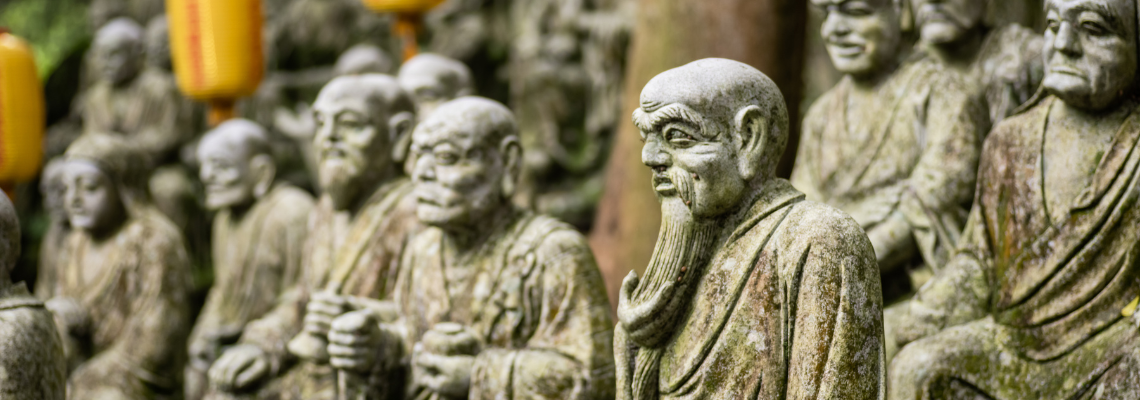
Next, we discuss “great Arhats.”
In Sanskrit, Arhat means “listener/sravaka.” Many of Shakyamuni Buddha’s disciples practiced the “inner cultivation of Bodhisattva path, outwardly manifesting the Sravaka vehicle.”
Each Arhat cultivates a specific skill for a very long time before they can become a great Arhat.
I remember that in Shakyamuni Buddha’s time, there was an Arhat named Elder Dhaka who followed Shakyamuni Buddha for a period. However, he was very dull-witted and foolish.
When Shakyamuni Buddha gave sermons, he would forget what was taught in the morning by the afternoon, forget what was taught in the afternoon by the evening, and forget what was taught in the evening by the next morning.
Dhaka could not receive the Dharma from Shakyamuni Buddha. In the end, Shakyamuni Buddha had no choice but to teach him:
“Remember these four words: ‘Guard mouth, control mind’, guard your mouth and control your mind.”
He taught him just these four words: “Guard mouth, control mind.”
At first, this Elder listened to the Buddha’s teaching of “guard mouth, control mind,” and he truly guarded his mouth, not opening his mouth even when eating. Finally, Shakyamuni Buddha told him, “You must open your mouth while eating.”
Good! He finally understood, and he kept his mouth shut except when eating.
Then the second instruction was that the Buddha told him to “control the mind.” But he did not understand how to do it. So Shakyamuni Buddha gave him an illustration: the inner mind, the outer mind, and the mind of emptiness.
From that point on, all day long he kept making comparisons between the inner mind, the outer mind, and the mind of empty space. In this way, he cultivated for a full thirteen years.
One day, when he pointed to himself, he noticed, “Hmm, there is a little light here inside.”
When he pointed outward, there was also a little light outside. When he pointed to the universe, light manifested throughout his entire body. Gradually, his obstacles disappeared, and his karmic obstructions were eliminated.’
One day, he went out with Shakyamuni Buddha, carrying Shakyamuni Buddha’s alms bowl. Shakyamuni Buddha was receiving offerings, a king had invited him to dinner, and he brought no one else but Elder Dhaka. Elder Dhaka carried the bowl and followed Shakyamuni Buddha into the city. Upon reaching the city gate, the guard, seeing Elder Dhaka, thought, “Why did Shakyamuni Buddha bring such a foolish and dull disciple?”
The guard only allowed Shakyamuni Buddha to enter for the meal. Everyone looked down on this foolish disciple, they thought he should just stand outside!
Shakyamuni Buddha entered the palace to eat with the king. But, as you know, monks always use a specific bowl when they eat.
Suddenly, a very long hand reached in from the sky, extending through the high city walls, passing through several doors and windows, until it reached the palace and handed the bowl to Shakyamuni Buddha.
The king was astonished: “What happened? How did a hand from the sky pass you this bowl so you can put your food in it to eat?”
Shakyamuni Buddha said, “My disciple, Elder Dhaka, is waiting for me outside the city walls. He cares about me and knew I was about to eat, so he brought this bowl to me from there.”
When people hear about such supernatural powers, they think, “I should learn that! I can just reach out and have whatever I want!”
But we can’t learn to have three hands, we have two hands, and there cannot be a third hand growing out from below them! You see, all our Buddha statues have many hands, but I’ve never seen one with three hands.
If you learn this supernatural power, you will be three-armed Bodhisattvas. The reason I’m telling this little story is to say that all Arhats, regardless of their level of wisdom, have undergone a long period of secret cultivation. Those with high wisdom can attain enlightenment, and those with low wisdom can also attain enlightenment.
This Elder Dhaka once went up on stage to give a sermon. People knew of his spiritual attainments and invited him to speak. He ascended the Dharma seat and, without saying a word, said, “Shakyamuni Buddha only taught me four words, and now I will teach you these four words: ‘Guard mouth, control mind.'”
After he finished speaking, he stepped down from the platform. Everyone below was astonished, not a single listener laughed at him. Because if one truly cultivates these four words and achieves them, one attains enlightenment.
In fact, our cultivation today is the same. Many disciples today immediately ask me to teach them Vajrayana. Some have only taken refuge for two days and want to learn the highest tantra. Others have only studied for a month and claim to have achieved complete understanding and want to become Masters. The Master offering they send me is two Malaysian Ringgit! Oh dear! I don’t even have enough for the postage! Therefore, when we study the Dharma, we shouldn’t be overly ambitious, nor should we try to learn every single teaching.
Today, they see the “Water Contemplation Practice” is good, so they want to learn it. Tomorrow, they see the “Homa Practice” is good, so they want to learn it. The day after tomorrow, they think flying is good, so they want to learn flying. Seeing everyone getting rich, they want the Wealth God Practice and then someone says: “Oh dear! No dharma practice is good, I want to learn the Spiritual Travel Practice”
I think this way of learning dharma is not good! This way of learning will definitely not lead to any achievement! It’s best to specialize in one method, and once you’ve attained a response from that practice, continue practicing it. For other practices, understand them, don’t practice them. This way, it’s easier to achieve enlightenment and attain realization.
When you have achieved enlightenment and realization, you can apply this knowledge to other practices and gradually be able to understand them all. When learning the Dharma, never try to learn ten, a thousand, or ten thousand methods at once. Never do that! Just by reciting one Buddha’s name, it is a very solid skill.
There are people who learn hundreds of mantras at once. Everyday in front of the Buddha hall, after reciting a hundred mantras, they’re sweating profusely. He wrote to me saying, “I’m always late for work.”
I told him, “You can save those mantras, just pick seven out of hundred over to recite.”
He said, “No way! I used to recite them, and if I don’t now, the Bodhisattvas will be angry.”
Actually, if you understand how to focus on one mantra with great concentration, that Bodhisattva is connected to all Bodhisattvas. For example, we currently focus on the mantras of the Eight Principal Deities, but many disciples, after finishing the mantras of the Eight Principal Deities, go and recite the mantras of over a hundred other deities as well. They recite all the mantras of over a hundred Bodhisattvas, and after a long time, the mantras of the Eight Principal Deities become less effective. This kind of recitation method doesn’t allow one to get a response easily.
Therefore, we only have one yidam, with the other seven surrounding it. The mantra of the principal deity can be recited 108 times, 1080 times, and the other mantras can be recited three times. The mantra of the principal deity is the main mantra, the other mantras are for developing affinity. This is the key to cultivation.
Nor can you say you’ve already become a Master, already learned the highest tantra, studied Vajrayana, and already achieved great accomplishments, and then suddenly you come to learn this… I can’t say it!
[The Master handling translation interjects “Guru Yoga”]
This… small skill.
Guru Yoga is the “Number One Great Dharma“!
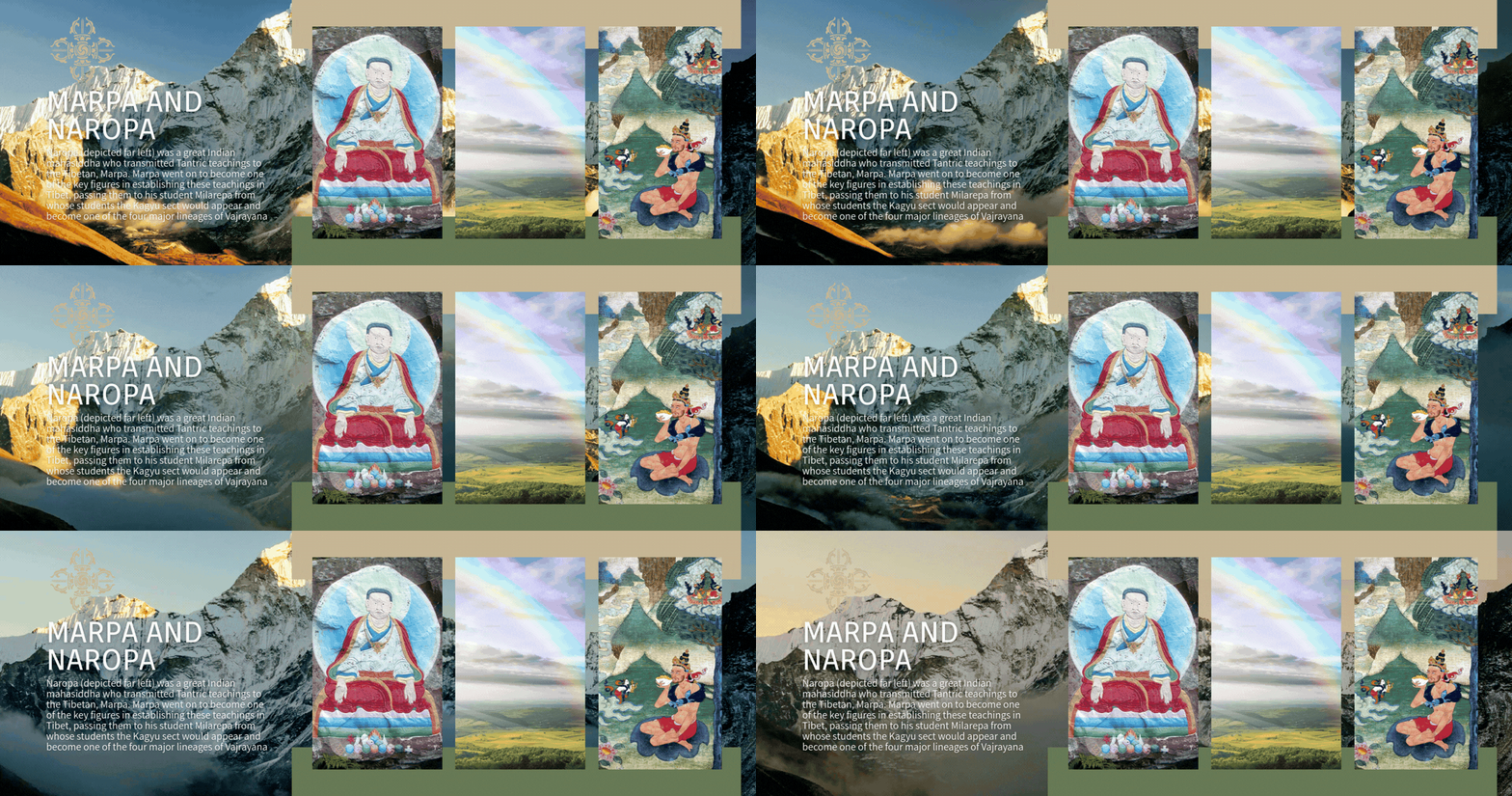
People of the world don’t know this, so let me tell you something. I’m only telling you this today because we’re discussing Guru Yoga. Guru Marpa went to India to seek teachings from Naropa. He found Naropa under a large tree. At that time, Naropa manifested a vast mandala for him, with all the Buddhas in the sky, but Guru Naropa himself was sitting beside the tree.
When Guru Marpa saw the manifested mandala, it was extremely majestic and adorned. He immediately prostrated to the mandala first, and only afterward prostrated to Guru Naropa.
Guru Naropa then said to Guru Marpa, “You bowed to the mandala first and only afterward to your guru. Because you have reversed the proper order of homage in this way, you will suffer the loss of your son.”
Guru Marpa asked Guru Naropa, “Why would I lose my son if I prostrated before the Mandala first before prostrating to you? What is my sin?”
What did Naropa say? He said:
“In Esoteric Buddhism, the guru is regarded as true, and the mandala as provisional. Without the Root Guru, how could there be a mandala? The mandala itself is the guru’s emanation. The most real and authentic is the Root Guru.”
Therefore, Tantric Buddhism differs from other schools. You all mistake the false for the true, and the true for the false. If you have read Tantric scriptures before, you would know: “The mandala is the false view, the root guru is the true view.”
Therefore, “the Root Guru is the First Visualization.” This is the supreme and unsurpassed supreme Dharma. Without placing the Root Guru as the first visualization, everything else is like a castle built in the air, like constructing a tall building in empty space. Can such a building ever truly be completed?
That is why this is extremely important. Ah, I’ve spoken too seriously. Amitabha!
Great Dharmas, the Lesser Teachings, and Middle Dharmas are all Dharmas. None should be treated with contempt. If even a slight thought of disparagement arises, that already constitutes the offense of negligence under the Bodhisattva precepts.
To speak frankly with everyone, I am still practicing the Four Preliminary Practices and Guru Yoga. This is an honest statement.