Once, Shakyamuni Buddha was discoursing the dharma on his dharma seat, surrounded by many great disciples, ordained bhiksus, bhiksunis, upasakas and upasikas. It was totally full, several thousands of them in total.
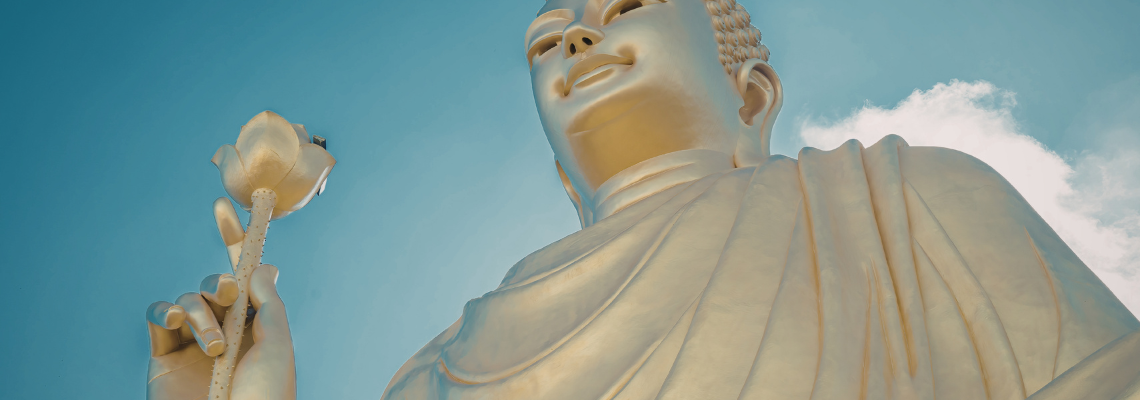
Shakyamuni Buddha casually picked a flower and placed it in his hand. He said nothing, simply holding the flower in his hand.
All the disciples saw Shakyamuni Buddha pick a flower and hold it silently. The disciples sitting below did not understand why he picked a flower. Why did he casually pick a flower for no reason and place it in front without saying a word?
They thought he was smelling its fragrance. Only Venerable Mahakasyapa saw Shakyamuni Buddha picking the flower and gave a slight smile.
At that time, none of the disciples understood Shakyamuni Buddha’s meaning, only Venerable Mahakasyapa knew.
Shakyamuni Buddha was transmitting the Buddha’s mind-seal, and Mahakasyapa knew that the mind-seal had been transmitted to him.
Because Mahakasyapa understood that he had received the Buddha’s mind-seal, he became the First Patriarch of the Zen lineage. This is the well-known story: “The World-Honored One held up a flower; Mahakasyapa smiled.”
Therefore, Venerable Mahakasyapa’s practice did not involve setting up an altar, it was not very solemn. His altar was simply in the void.
His Dharma was not written into words, it was about using his own mind, his enlightened mind to verify the enlightened mind of others.
This is “Zen”.
Venerable Mahakasyapa was the first patriarch of the Zen school.
Venerable Mahakasyapa was also a person who “had a beginning but no end.”
Among the ten Great disciples, his cultivation was exceptionally masterful. The phrase “had a beginning but no end” means he was born but did not die.
After Shakyamuni Buddha’s passing, the first compilation of all the Buddhist scriptures was under the leadership of Mahakasyapa.
After completing these tasks, he went alone to a mountain called Kukkutapada. When he reached the mountainside, the mountain opened to let him in, and then closed again.
At that time, he said, “When Ajita Bodhisattva is born in the Saha world in the future, at the three Nagapushpa assemblies under the Dragon Flower Tree, I will come forth to serve as a Dharma protector.”
Ajita Bodhisattva is the same as Maitreya Bodhisattva.
This proves that he did not die at all. He entered Mount Kukkutapada and is said to remain there even now, possibly still in meditation.
After Maitreya Bodhisattva is born, the door of Mount Kukkutapada will open and he will come out again.
At present, he is said to be in meditative absorption beneath the earth, like being in hibernation. This is regarded as something very extraordinary.
The path of Venerable Mahakasyapa’s practice was entirely focused on self-cultivation. Therefore, he was an Arhat, a very special representative among Arhats. Among the ten Great disciples, he was known as “the foremost ascetic.”
Throughout his life, he was never lax. He strictly cultivated and performed his rituals daily, drinking river water and eating simple food. He did these things everyday.
Also, whenever he walked, he always kept his eyes focused on what was six feet in front of him, never looking around. He had a very strict precept of not speaking to women, so he was never troubled by women in his life. Unlike another venerable monk who had many women troubles, Venerable Mahakasyapa had no women difficulties. Maybe Mahakasyapa was considered less attractive.
He was a very typical and unique figure among the Buddha’s ten Great disciples.
As a matter of fact, his wisdom and enlightenment were very real.
Om mani padme hum.