
Tonight we continue talking about the “Amitabha Sutra.” Last Saturday we talked about the “Seven Limbs of Bodhi.” Today, we talk about the “Eightfold Path of Sages.”
In Chinese, the “Eightfold Path of Sages” has the word “right” in it, which is the so-called Right Path. Which means walking on a Right Path, our cultivation is to walk on the Noble Path.
The “Eightfold Path of Sages” is to divide up the Right Path into eight principles to explain:
The first is the “Right View.”
This “view” refers to “correct understanding.” When Shakyamuni Buddha first expounded the Dharma, he taught the Four Noble Truths. The Four Noble Truths are:
suffering,
its cause,
its cessation, and
the path to its cessation.
Understanding the principles of suffering, its cause, its cessation, and the path is a kind of “Right View.”
The earliest Dharma taught by Shakyamuni Buddha was the Four Noble Truths, and the final Dharma He taught was also the Four Noble Truths.
The second is the “Right Thought.”
This means your thoughts are very correct. Your thoughts are very correct because you use the right views of the Four Noble Truths to lead to thoughts, which are right thoughts.
“Right view” and “Right Thought”, one is referring to correct and right views and the other is referring to correct and right thoughts.
The third is the “Right Speech.”
If the things we normally say out loud are very just, also very correct, rational, that is called “Right Speech.”
The so-called “Right Speech” also includes not using frivolous speech, so what is frivolous speech?
Sometimes it is very hard to explain. In the past, when we started to learn English. Some teachers said, “You should start learning English with rude words”.
Why did the English teachers tell us to start with pornographic language?
Because it is more appealing to people.
Back in university, I had a classmate who frequently read English novels. He studied English very diligently, immediately looking up anything he didn’t understand in the dictionary.
I asked, “Why are you so diligent?”
He said, “Because they’re pornographic novels!”
The plots are very engaging, easily stimulating his interest in learning. If it was proper English he wouldn’t be able to continue reading. He only diligently looked up words in the dictionary for pornographic novels. The dialogue in these novels is frivolous speech.
One very important point of “Right Speech” is not to engage in “divisive speech”.
This point is very important, because divisive speech is very scary.
I find that in the human world, there are many people who chatter non-stop. Chinese people say,
“Talking about the shortcomings of the Zhang family and the affairs of the Li family.”
Now he runs to this family to talk about that family, next he runs to that family to talk about this family, this is called divisive speech.
People who practice “Right Speech” do not engage in divisive speech.
In reality, it’s rare to find a truly upright person in the world. Everyone has flaws.
As practitioners, we should praise the virtues of others while concealing their faults and learn the strengths of others and avoid pointing out their weaknesses. Only in this way can we truly learn “Right Speech.”
I think about what Confucius said in the past:
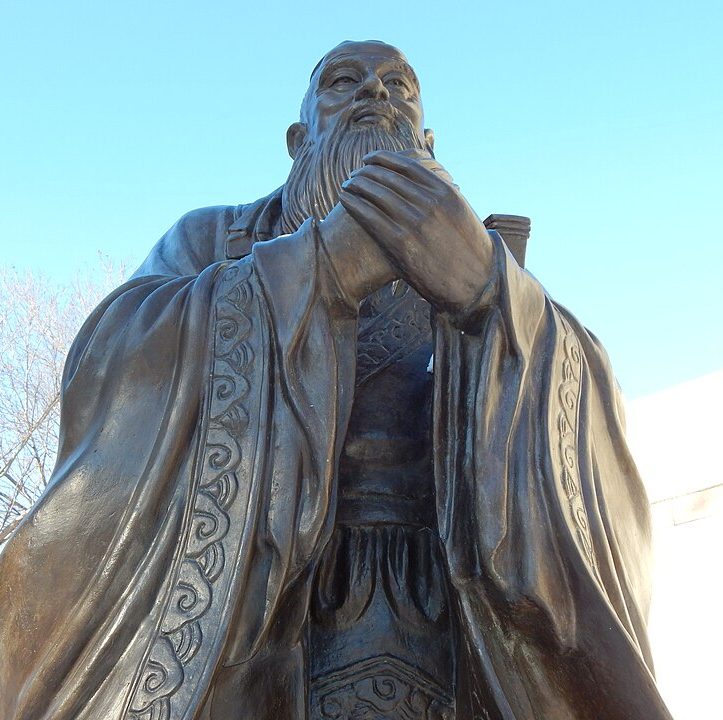
This is probably referring to “Right Speech.”
I once read books about seven-generations, three-generations, and multi-generational families, and a common saying they all have was:
“Don’t listen to madam’s words.”
Because if you listen to madam’s words then it is finished, half a generation won’t be able to live together. Of course, men also sometimes have divisive speech, but women are more prone to it. Therefore, both men and women must uphold “Right Speech.”
An even worse kind is “foul language,” what comes out of the mouth is swearing, three-character curses, five-character curses, there are four-letter swear words in English. These are all bad because they are deviant and not “Right Speech.”
Why does cultivation teach people to recite the Buddha’s name?
Because when reciting the Buddha’s name one can calm their mind.
Why do we teach you all to recite mantras?
Because when reciting mantras, one would not use foul language. Mantra is a form of “Right Speech,” the Buddha’s name is also a form of “Right Speech.” Reciting the Buddha’s name and chanting mantras can control your verbal karma, purifying your verbal karma.
Fourthly, we talk about “Right Action.”
Right Action is not evil karma, but positive karma; pure deeds belong to what we call Right Action.
Fifthly, we talk about “Right Effort.”
Effort is effort, so why add the word “Right”?
Walking on the Right Path is then called “Right Effort.” Otherwise, even though you understand the principles of effort, if the dharma you practice is not correct and has deviated and you haven’t realized it, such effort is useless.
What is the purpose of studying the Dharma?
If you study the Dharma to gain supernatural powers, to surpass everyone, and to defeat all Dharma masters, that’s not Right Effort. Many people who study swordsmanship, practice diligently to kill everyone who knows swordsmanship and become the best in the world. That is also not Right Effort. Some people are very diligent, but they look for other fellow disciples to compare who is higher, and after gaining spiritual powers, they use them to cast curses on others, this is also not Right Effort.
In the past Milarepa, the founder of the Kagyu school of Tibetan Buddhism, went to study dark magic under Ngakpa Yonten Gyatso. The dharma he learnt was based on hatred, with the goal of killing those who had wronged them in the past. This was because the villagers had bullied them, calling them orphans and widows, and driven them out of the village. So upon returning after learning sorcery, he sought to punish those villagers.
Milarepa learned the art of hail summoning and returned to his village to perform rituals that caused hail to fall, destroying all the wheat and rice. It was as if the more others suffered, the happier he felt.
Like a doctor who learned this dark magic, he performed a ritual in a village, and the whole village was afflicted with a plague, all seeking his treatment.
A coffin seller performed a ritual, and half the village died. Learning dharma like this is not “Right Effort.”
Milarepa was very powerful. Those great aunts and aunts who had previously bullied him were having a wedding feast in their new house when he performed a ritual. The moment he did the ritual, oh dear!
My God!
All the rats gathered to gnaw on the pillars of the new house.
Termites also gathered together, eating away the four pillars.
Upstairs, people were drinking and eating at the wedding feast and also happened to be moving house, a joyous day for moving.
Unexpectedly, the pillars were eaten, causing the entire building to collapse, crushing to death over twenty people.
Although Milarepa’s powers were extremely strong, in reality this is not considered “Right Effort” because the dharma being used was improper. Therefore when we learn the dharma it has to be the “Right Effort.” The Four Noble Truths is a right dharma. The most important thing is that the more we learn, the more tranquil, the more peaceful our minds should become. We should enter the tranquil Nirvana, and not become more combative as we learn the dharma.
There was a time when Grandmaster thought that I was number one in the world, when I met any Dharma Masters more powerful than me I would settle scores with them.
Now it’s different, now I am the last one in the world, now I don’t dare.
When I first started learning the Dharma, I felt that I was very powerful, that throughout the universe, up and down the ten directions I was the highest, that I am the Buddha.
Under the sky among the people, there is always someone stronger, one mountain higher than the other, the behind waves of the Yangtze River pushing forward the waves before them, and each new generation replaces the old. The older I get, the less sharp my mind becomes, the more confused I get. Newborn tiger cubs are fearless and afraid of nothing, newborn calves are unafraid of tigers, but now I’m afraid of everything.
When I first started learning Buddhism, the Buddha was in front of me. After learning Buddhism for fifty years, the Buddha is far away.
The wisdom of life is very vast and perfect. It is not something our very small lives can finish learning.
The reason I dare not be number one in the world anymore is because the more I learn, the more afraid I become. The more I learn, the more insignificant I become, the more I learn, the more I dare not be arrogant. In the end, I can only close my mouth and not speak. Therefore through the Four Noble Truths, one can move towards Nirvana, the mind is tranquil and peaceful as all is understood.
We will talk about the sixth, “Right Concentration.”
The “Concentration” mentioned here is not referring to meditation but referring to “not moving.”
It means to walk on this Right Path with a focused mind, without turning back, not retreating from the original aspiration.
Grandmaster already will not retreat from my original aspiration, as I have already made up my mind with determination, to walk until the end of this road in this lifetime.
Actually among those who come to cultivate, or those who come to take refuge, those who have the “Right Concentration” and do not waver are not many.
Having perseverance, being able to cultivate, having a focused mind, and not wavering in their decision, that is called “Right Concentration.”
The seventh is “Right Mindfulness.”
Right Mindfulness means that one’s thoughts are completely correct. Here it is explained as “the mind is unmoving.”
We know that through our mind, we can eliminate all external conditions.
Everyone says, “My mind is no longer moving”.
However the moment the environment changes, the mind moves. A person’s mind is actually influenced by the external environment. I said before, here one is reciting Namo Amitabha Buddha, Namo Amitabha Buddha, suddenly a beautiful lady walks past the doorway. You think “Namo Amitabha Buddha is so beautiful!”
Actually, Amitabha Buddha isn’t beautiful, Amitabha Buddha is majestic.
Your mouth is still reciting Namo Amitabha Buddha but your mind has moved.
The human mind is indeed not easy to cultivate to the state of immovability. Our thoughts are often tempted by the external environment, so the Right Mindfulness is about guarding the mind so it is unmoved.
Perhaps you all think that you have cultivated very well already, your mind is already unmoving.
Actually, how do you test if your heart is unmoving?
It’s very simple. Now just close your eyes for a moment.
What do you think about when you close your eyes?
Maybe the moment you close your eyes, your girlfriend will appear in your mind.
Maybe the moment you close your eyes, you see your enemies.
Sometimes the moment you close your eyes, you find that your mind is speaking, actually your mind is all about scolding people.
Or the moment you close your eyes, oh dear! Oh no, just now I saw a magazine, there was a beautiful lady, she appears now in my mind.
The mind is always in moving; it is never unmoving. Claiming that one’s own mind is unmoving, when one has not yet cultivated, is self-deception.
Those who work with stocks, their whole mind is full of stocks.
Those who like politics, their minds are already thinking of elections.
Those who like philosophy, their minds are filled with philosophical theories.
Think about it, has your mind ever been still?
So Buddhism teaches that one should have the “Right Mindfulness,” which is referring to an unmoving mind.
The eighth is called “Right Livelihood.”
Generally speaking, this “Right Livelihood” is also rather difficult to explain. The Buddha has spoken before about the Five Kinds of Wrong Livelihood. As long as we reflect carefully on them, we will be able to distinguish clearly between “Right Livelihood” and “Wrong Livelihood.”
The first type is called “manifesting strange appearances.”
It means behaving differently from others. For example, when we’re all taking a group photo, I noticed one disciple always sticks his head out like that, which is strange. No matter which photo he’s in, his head looks like that. This is called “manifesting strange appearances,” constantly trying to show that one is different from others.
This explanation may not be entirely accurate, but this is manifesting strange appearances. Some people like to show off, and actually showing off is also a good thing, but it should happen naturally. Don’t specially do strange acts just to seek attention. The Buddhas and Bodhisattvas feel that this is hypocritical, because of your hypocrisy and manifesting of your strangeness, this is then not Right Livelihood.
The second type is “boasting of one’s own merits and virtues”.
A person feels that they are great and thinks that they have a lot of merits, high like the heavens. They might say “I have done so many good deeds, printed so many sutras, delivered so many people, donated so much money. I have went to a venue with tens of thousands of person to expound the Dharma and liberate sentient beings. No one’s merits can compare to mine.”
This is also Wrong Livelihood. Because in the eyes of the Buddhas and Bodhisattvas, so-called merit is actually no merit. No merit is then actually real merit. When we do good deeds, we should not harbor thoughts of merit, that is then real merit. If we perform good deeds with the intention of gaining merit, the merit is then halved. Therefore, constantly praising that one’s merit is great, that is a type of Wrong Livelihood.
The third type is fortune telling for others, “divination of good and bad fortune.”
Actually, fortune telling isn’t always bad, as long as the intention is to guide people towards goodness or lead them to Buddhism, then the intention is good. However, if it only speaks of good or bad fortune without guiding people towards the right path, then it’s a Wrong Livelihood.
Even worse, if it’s used to extort money, intimidate, or even sexually exploit people, this is a Wrong Livelihood based on divination of good and bad fortune.
In the past, we used to go to a fortune-telling place, the fortune-teller said “Oh dear! This is terrible! You have to wear white this year.”
He didn’t say it directly clearly, only said wearing white clothes, which we found strange.
What does wearing white mean?
Does it mean our clothes are always white and clean?
In Chinese custom, wearing white signifies a death in the family, like wearing mourning clothes. After understanding this, we thought, “What should we do? Is it my grandparents, father, or mother? Who is it?”
We generally hope our elders will live long and healthy lives, hearing about a death this year fills us with panic.
At this moment, the fortune teller took a hammer, chipped a small piece of stone from a rock, wrapped it in a piece of yellow paper, and said, “This thing can save your family’s life. Do you want it?”
Of course, we said yes! How could we not want a small stone that could save our family’s life! Beside him there was a pen holder, he took the stone to the top of the pen holder and said “You want, XXX amount, don’t want I will throw it in.”
Of course, there was a real struggle in my heart at that moment, because not taking it meant losing a family member, and taking it meant handing over a certain amount of money. Ah! I knew this fortune teller’s tricks, so I told him, “I don’t want.”
He said, “If you don’t want it, I’ll really throw it down and die.”
I still didn’t waver and said no.
Why?
Because I couldn’t afford that much money at that time, and I was also very stingy.
In fact, it was a scam! There was no such thing at all. But the fortune teller was just using the psychology of “Do you want him to live or die?” to scare you into handing over the money.
The fourth Wrong Livelihood is to “show off one’s power and influence loudly.”
Actually, I think there’s some meaning to what Shakyamuni Buddha said about this. I’ve noticed that those who show off their power and influence loudly are either high-ranking officials or wealthy people. Because if they don’t show off their power and influence loudly, no one knows they are rich and powerful.
Wealthy people speak louder, at least they are speaking while standing on top of piles of money.
However, when Buddhas and Bodhisattvas talk about showing off one’s power and influence loudly, they mostly refer to wealthy people, or high-ranking officials, or people with good fortune. Those who are wealthy and hold high positions are so because they have good fortune, so sometimes there’s nothing wrong with showing off their power and influence loudly!
Actually, being humble is better than showing off one’s power and influence loudly, otherwise, one will be criticized [like the Taiwanese saying] for “smelling too much like a cesspool”. Being arrogant and stinking sky high, easily makes people feel resentful or incites conflict, so this is also a type of Wrong Livelihood. Therefore, the more humble high-ranking officials and wealthy people are, the more respect they will receive.
The fifth is “speaking about personal gain.”
For example in the area of cultivation, like this morning someone called to say. “Guru, I have gained enlightenment.”
I told him, “Congratulations to you!”
A few days later, he calls again to say, “Guru, I haven’t attained enlightenment.”
To be honest, it’s normal for him to say he hasn’t attained enlightenment. If he said he has attained enlightenment, I’d be very sad, because their mind might already be in trouble!
In the past, someone called me and said, “Guru, I attained enlightenment last night!”
Ah! I was very worried, because a few days later he would definitely be sent to a mental hospital. So, attaining enlightenment isn’t about talking with your mouth, it’s not about using your thoughts, and it’s not about demonstrating it with your body. It’s about truly being enlightened in your heart, being extremely peaceful and tranquil.
Someone once called me and said, “Master, I went to the Maha Twin Lotus Pond in the Western Pure Land of Ultimate Bliss, and saw you there.”
I asked, “What did you see me as?”
He replied, “You were a little green frog in the Maha Twin Lotus Pond.”
Not long after, the problem became very serious, and he was admitted to a mental hospital. Therefore, those who claim to have attained enlightenment are not truly enlightened, their supernatural powers went overboard, leading to delusions, this is Wrong Livelihood.
True supernatural powers are no supernatural powers, because your mind revolves with the universe, occurring naturally, therefore naturally there are no supernatural powers. Everything is natural, an enlightened person is truly free from worldly strife, at peace in their heart and mind.
This “Eightfold Path of Sages” is called the “Eightfold Noble Way Dharma”.
Like eight boats sailing on the right path, capable of crossing the river of afflictions, delivering through the shores of birth and death, reaching true Nirvana.
This concludes the explanation of the Eightfold Path of Sages.
Om Mani Padme Hum